Cavallo Companion
Horse Hoof Trimming: What Does a Good Barefoot Trim Look Like?
A good barefoot trim helps maintain the shape, balance, comfort, and natural function of an unshod horse’s hooves.
It may sound as simple as shortening and balancing the hoof wall, but there is much more to it than that. A thoughtful hoof-care provider will be looking at how your horse stands, moves, loads each foot, and wears its hooves between appointments.
Every horse is different, so there is no one measurement, angle, or hoof shape that suits them all. Breed, conformation, movement, terrain, workload, hoof health, and very importantly, previous hoof care can all influence the trim. Your trimmer has a great deal to consider. Still, there are useful landmarks that owners can learn to recognize as they follow their horse’s progress between appointments.
Understanding the basic requirements of a properly functioning hoof makes it easier to notice changes, ask informed questions, and work closely with a qualified hoof-care professional.
What Is a Barefoot Hoof Trim?
A barefoot trim maintains a horse’s hooves without permanent metal shoes. The hoof wall is shortened and shaped as needed, while the heels, bars, frog, sole, and white line are assessed with an eye to health, comfort, and balance.
A good trim works with the individual horse. It respects that horse’s conformation while gradually addressing excess growth, flares, imbalance, and distortion. The goal is not to force every hoof into the same “ideal” shape. It is to find the trim that is most beneficial for that particular horse, supporting healthier, more functional feet over time.
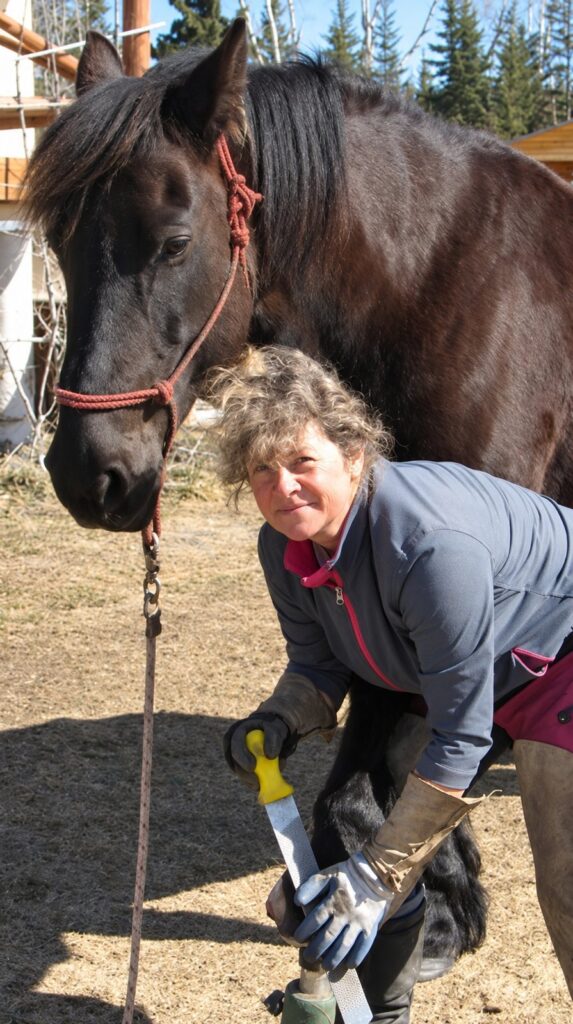
Before trimming, a hoof-care professional may watch the horse stand and move. This can reveal things that cannot be seen by examining a lifted hoof alone. Landing pattern, stride, limb alignment, twisting, and uneven loading can all help guide the trim.
After trimming, the foot should be reassessed both lifted and weight-bearing.
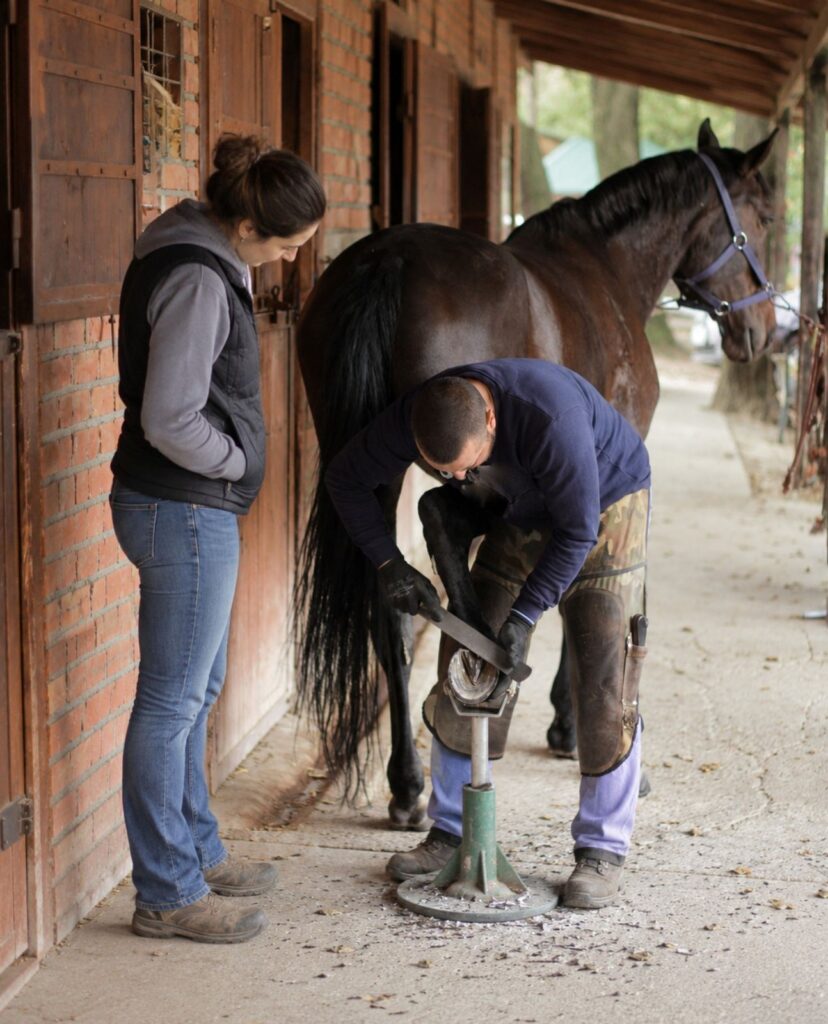
Why Do Barefoot Horses Need Regular Trimming?
The hoof wall grows continuously, much like a human fingernail. Movement over firm, varied terrain can naturally wear some of that growth away. However, most domestic horses do not travel far enough or live on sufficiently abrasive ground to keep their hooves evenly maintained on their own.
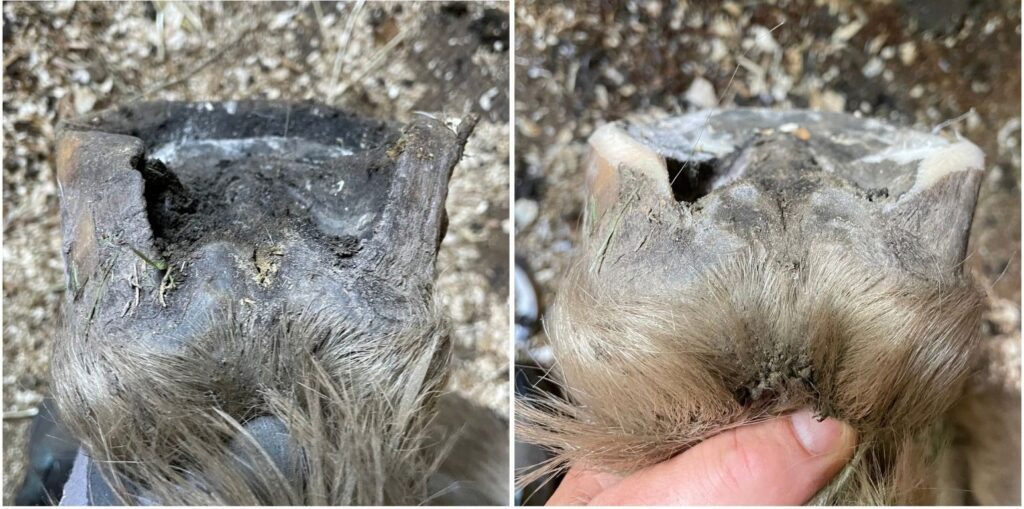
When growth exceeds wear, the hoof can become too long or begin to distort. The toe may migrate forward, the heels may grow tall or run forward, the quarters may flare, and the hoof wall may chip or crack. If distortions become significant, they can invite further complications such as white line disease, seedy toe, and in some cases conditions associated with mechanical stress, including navicular problems or laminitis.
Regular trimming helps keep the hoof capsule organized around the internal structures of the foot. It also reduces the amount of correction needed at any one appointment. Small, timely adjustments are generally much easier on the horse than allowing substantial excess growth to develop and then trying to correct everything at once.
A consistent schedule is especially important for horses growing out old damage, transitioning out of metal shoes, recovering from hoof distortion, or being fitted for hoof boots.
How Often Should a Barefoot Horse Be Trimmed?
Many barefoot horses are trimmed approximately every four to six weeks. However, the right schedule depends on the individual horse and can change throughout the year.
Some horses may need attention every two to three weeks, particularly when correcting imbalance or during periods of rapid growth. Others may comfortably go four to six weeks or longer when growth is slower, and the hoof wears evenly.
Factors that affect the trimming schedule include:
- Season and rate of hoof growth
- Amount of movement and natural wear
- Terrain and footing
- Diet and overall health
- Age and workload
- Hoof distortion or disease
- The horse’s individual movement and loading pattern
Rather than relying only on the calendar, watch your horse’s hooves between visits. A toe that is becoming long, a widening flare, cracking around the lower wall, increasingly uneven growth, or a change in movement may indicate that the current trim cycle is too long.
What Does a Balanced Barefoot Hoof Look Like?
The finished hoof is usually compact and approximately round or slightly oval, depending on the individual foot. Front hooves are often rounder, while hind hooves may be somewhat more pointed or oval because they perform a different role in movement.
From the front, the hoof wall should appear reasonably centred beneath the limb. From the side, the toe should not look excessively long or pulled forward, and the heels should not appear crushed or run far underneath the hoof. The hoof wall angle should correspond roughly with the angle of the pastern.
There are many theories about proper toe and heel angles. We do not believe a one-size-fits-all approach is appropriate, adequate, or correct for every horse. The whole horse needs to be considered.
The sole view provides additional information about heel position, frog, bars, white line, wall length, and the overall proportions of the foot. A balanced trim should help the horse stand and move comfortably while keeping the hoof capsule reasonably aligned with the limb. It should not remove protective structure simply to create a tidy-looking hoof.
Understanding the Heels, Quarters, Bars, and Toe
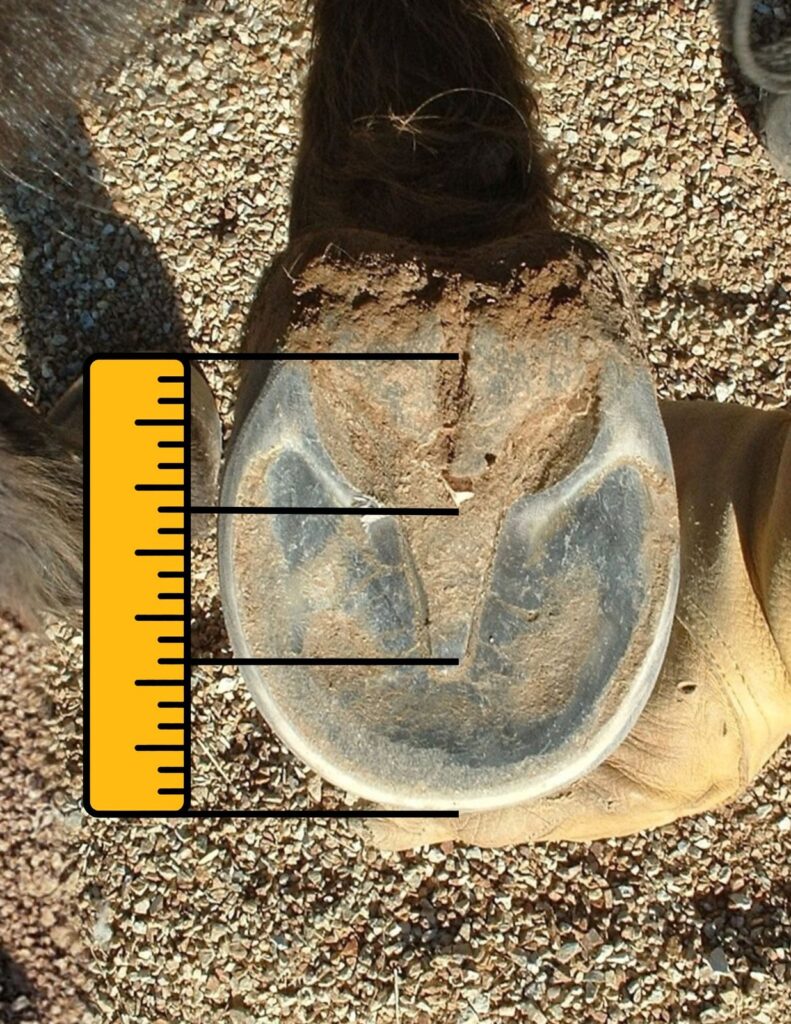
One helpful way to study hoof proportions is to divide the bottom of the hoof lengthwise into three approximate sections:
- The heel third at the back of the foot
- The quarter, or middle, third
- The toe third at the front
In a well-proportioned hoof, the frog generally occupies the rear two-thirds of the foot, leaving approximately one-third of the hoof ahead of the frog’s apex. If the area in front of the frog looks unusually long, the toe may have migrated forward or developed excess length.
The bars are inward folds of the hoof wall that begin at the heels and run forward on either side of the frog. They should generally follow a fairly straight path, run roughly parallel to the frog, and end around halfway down its length. Bars that extend too far forward, curve outward, fold over, or rise prominently above the surrounding sole may be overgrown or distorted and should be assessed by a qualified hoof-care professional. These proportions are helpful observation tools, not exact formulas.
What Should a Healthy Frog Look Like?
The frog is the triangular structure in the centre of the hoof. It should be broad enough to fill much of the back of the foot and should not be buried between narrow, contracted heels.
A healthy frog generally appears:
- Open and reasonably broad
- Firm, but slightly yielding
- Free from deep central cracks
- Free from loose, diseased, or foul-smelling material
- Well positioned between the heels
The grooves beside the frog naturally collect some dirt, but they should not form deep pockets. A narrow crack extending between the heel bulbs can trap moisture and debris and may be associated with thrush or heel contraction.
Frogs naturally shed excess material, so a slightly ragged surface does not always mean something is wrong. Aggressively trimming healthy frog tissue is not usually necessary and may remove protection the horse needs for comfort.
What Should the White Line Look Like?
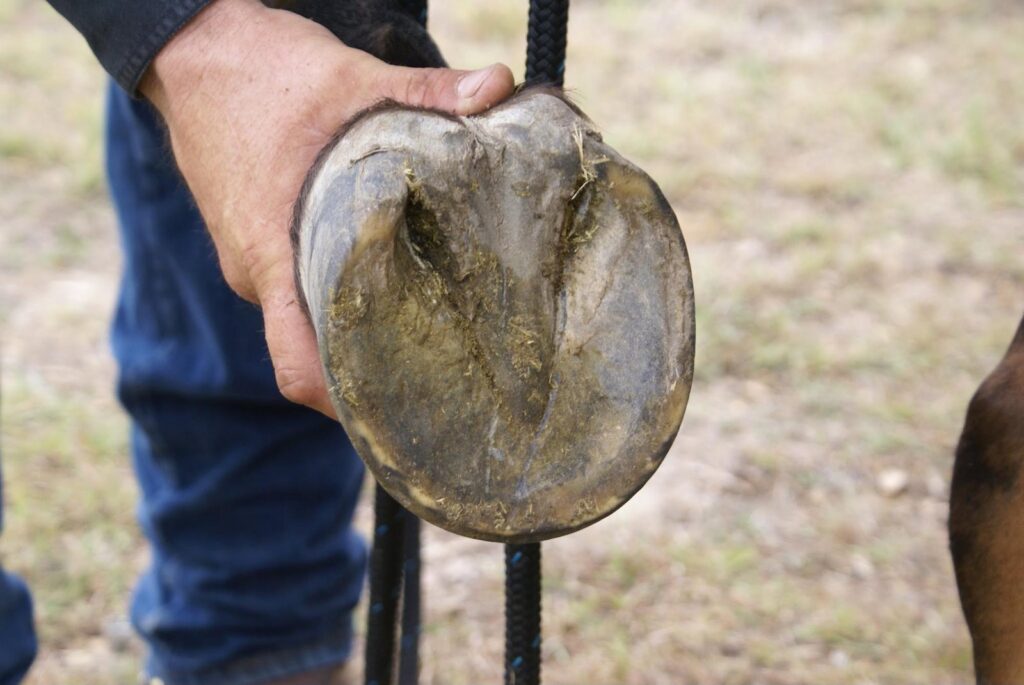
The white line is the connection visible between the hoof wall and the sole. Despite its name, it often appears cream, yellow, or light tan.
A healthy white line should form a relatively tight, narrow connection around the hoof. When it becomes stretched or widened, particularly through the toe and quarters, it may indicate that the wall is pulling away from the internal hoof structures.
White-line stretching may accompany a long toe, flaring, mechanical stress, laminitis, or white line disease. Discuss it with your horse’s hoof-care professional. Veterinary input may also be needed if there is soreness, significant separation, heat, a stronger digital pulse, or concern about laminitis.
Comparing the Heel and Toe Angles
Viewed from the side, the angle of the heel tubules and the angle of the dorsal hoof wall should generally be similar. The dorsal wall is simply the front surface of the hoof.
When the heel angle is much lower than the dorsal wall angle, the heels may be underrun or collapsed forward. When the heels are considerably steeper or taller, the foot may be too upright or carrying excess heel height. These differences need to be interpreted alongside the horse’s conformation, rather than judged from one angle alone.
Side photographs can make gradual changes easier to see. Take the photo on level ground with the horse standing square. Keep the camera close to ground level and centred beside the hoof. Photographs taken from above can make toe and heel angles look misleading.
Another general visual check uses the coronary band of a hind hoof. In a true side photograph of the whole horse, imagine extending a line forward along the angle of the hind coronary band. Depending on the horse’s build, that line should generally travel toward the area around the knee. A line falling much higher at the elbow or above may suggest a long toe, low heel, or hoof-capsule distortion.
Like every external landmark, this is a screening tool rather than a diagnosis.
Checking Medial and Lateral Balance
The medial wall is the inside wall of the hoof, while the lateral wall is the outside. An easy way to remember this is: medial starts with “M,” for middle.
In overgrown hooves, a relatively common pattern is for the medial side to become taller while the lateral wall flares outward. However, this is not true for every horse. Trimming both sides to look identical can create problems if the limb itself is not symmetrical.
Medial-lateral balance should be evaluated with the hoof both lifted and weight-bearing. The hoof-care professional must consider limb conformation, heel height, coronary-band shape, landing pattern, and how the horse naturally loads the foot.
Owners can watch for uneven wall height, one heel appearing taller, one side flaring more than the other, or the horse consistently landing on one side of the hoof first. These are helpful observations to share, but they do not determine how much material should be removed.
Why a Good Trim May Not Look Perfect
Hoof distortion develops over time and usually needs time to improve. Removing too much wall, sole, heel, or frog in one appointment can leave a horse uncomfortable and reduce important protection.
A knowledgeable hoof-care provider may therefore make gradual changes over several trim cycles. New, better-connected hoof wall must grow down from the coronary band, and that can take many months.
Your horse’s comfort and improved function are far more important than making the hoof look perfectly symmetrical after one appointment.
Barefoot Trimming for Hoof Boots
Barefoot horses still need protection on terrain that is harder or rockier than their regular living environment, especially when they are ridden, as the additional weight compresses the sole further into the ground. Hoof boots provide sole protection and cushioning when needed, while still allowing the horse to remain barefoot inside the boots and when the boots are removed.
Boots are helpful for riding, turnout, rehabilitation, and the transition out of metal shoes. Cavallo boots are used by many barefoot trimmers, hoof-care practitioners, farriers, and veterinarians around the world.
It is important to measure each hoof carefully and select the proper size. Hoof growth changes a hoof’s dimensions, so allowing the trim cycle to run too long can make a boot too small. Conversely, trimming too short can contribute to twisting or movement within the boot.
For owners who would like to understand more about the process, Cavallo’s short trim video and Barefoot Trim Manual provide additional visual information. The detailed trimming instructions are intended for qualified and experienced hoof-care professionals, but owners can still use these resources to learn the terminology and recognize the landmarks being discussed.
The Most Important Part of Barefoot Trimming
A good barefoot trim is not defined by one angle, measurement, or trimming method. It combines regular professional care with careful observation of the whole horse and, perhaps, a modest openness to continued learning, new information, or even a change of approach when the horse needs it.
When checking your horse’s feet, look at overall hoof shape, heel position, frog, white line, wall connection, toe length, and medial-lateral balance. Then consider the most important question of all: how comfortably is your horse standing and moving?
Clear photographs, notes about changes in movement, and regular conversations with your hoof-care provider can help you follow progress over time. If your horse becomes sore, develops sudden heat or strong digital pulses, or shows rapid changes in hoof shape, involve your veterinarian as well as your trimmer immediately. The more you understand what you are seeing, the more confidently you can participate in your horse’s hoof-care journey.
Ready to choose?
Find the Right Boot for Your Horse
Boots help with riding, turnout, rehabilitation and the transition out of metal shoes. Measure each hoof after a fresh trim, then choose the boot that suits your horse.
Sources
- O’Grady, S. E. “Guidelines for Trimming the Equine Foot: A Review.” Proceedings of the American Association of Equine Practitioners, vol. 55, 2009, pp. 215–225.
- O’Grady, S. E., and H. M. Clayton. “Barefoot Methodology as a Viable Farriery Option.” Equine Veterinary Education, vol. 36, 2024, pp. 423–430.
- Parks, A. H. “Form and Function of the Equine Digit.” Veterinary Clinics of North America: Equine Practice, vol. 19, no. 2, 2003, pp. 285–307.
- Martinson, K., M. Boyce, and K. Otterson. “Caring for Your Horse’s Hooves.” University of Minnesota Extension, reviewed 2024.
- Herder, C., and L. Seeley. The Cavallo Barefoot Trim: A Guide for Keeping Horses in Their Natural Barefoot State. Cavallo Horse & Rider Inc., n.d.