Cavallo Companion
How to Choose Hoof Boots: A First-Time Buyer’s Guide
Choosing hoof boots for the first time can feel a little overwhelming. There are different styles, materials, sizes, and features, and if you are new to hoof boots, it can be difficult to know which details really matter.
We always suggest starting in the simplest place: with your horse.
Take a good look at the shape and measurements of each hoof. Think about where you ride, the type of terrain your horse travels over and how often you expect to use the boots. A well-chosen hoof boot should fit securely, protect the foot comfortably and stay in place without interfering with the horse’s natural movement. Just as importantly, it needs to be practical enough that you are happy to reach for it whenever your horse needs some extra protection.

What Are Hoof Boots Used For?
Hoof boots provide removable protection between the hoof and the ground. They can be used for trail riding, arena riding (jumping, dressage, flatwork, etc.), rocky or hard terrain, barefoot transitions, turnout, transport and rehabilitation, or simply to protect a hoof temporarily when a shoe has been lost.
A barefoot horse may be perfectly comfortable wandering around the pasture and then become noticeably more careful when asked to cross gravel, pavement, frozen footing or a rocky trail. That doesn’t necessarily mean there is something wrong with the horse or that being barefoot isn’t working. The ground has changed, and it is simply asking more of the foot.
To us at Cavallo, that is one of the great advantages of hoof boots. You can protect the hoof when protection is needed and allow it to remain barefoot when it isn’t.
Begin with Accurate Hoof Measurements
Hoof boots are fitted to the hoof, not to the horse’s breed, height or body weight. Two horses of exactly the same size can have completely different feet. In fact, even the four hooves on the same horse may not measure exactly alike.
Measure each hoof individually, ideally immediately after a fresh trim. For Cavallo sizing, measure from the toe to the back of the weight-bearing heel, excluding the heel bulbs, then measure across the widest part of the hoof.

Both measurements matter because hoof shape matters. Some hooves are naturally rounder, while others are longer and more oval. Cavallo Regular Soles are designed for rounder hooves, while our Slim Soles are approximately ¼ inch (6 mm) narrower and better suited to a more oval-shaped foot.
If your measurements land close to two sizes, don’t guess. Send us some clear photographs. Sometimes we can see something in the shape of the hoof that the numbers alone don’t tell us.
Remember That Hooves Grow
People sometimes assume they should buy a larger boot to leave room for the hoof to grow between trims. With Cavallo, you don’t need to automatically size up. Our sizing already allows for normal hoof growth during a typical six-to-eight-week trim cycle, and the closures can be adjusted as the hoof grows.
In fact, a boot that is too large can create more problems than one that fits correctly. Too much room allows the hoof to move around inside the boot, which can lead to twisting and may even allow the boot to come off.
Regular trimming is part of good boot fit too. Long toes, flares and significant changes in hoof shape will affect the way any boot sits on the foot. We like to remind people that a boot can only fit the hoof that is inside it.
Will Hoof Boots Stay On?
This is one of the questions we hear all the time, and the answer is yes: a properly fitted hoof boot should stay securely in place during riding and exercise.
Cavallo boots conform around the hoof and use adjustable closures to create a snug, comfortable fit. If a boot repeatedly twists or comes off, we want to look at size and hoof shape before reaching for more straps or simply tightening everything. The answer is usually in the fit.
When your horse first starts wearing boots, introduce them gradually. Start with walking and shorter rides, and give both your horse and the boots time to settle in. You can then progress to faster work, uneven terrain, longer distances and whatever activities you and your horse normally enjoy.
Correctly fitted Cavallo boots are used for trail riding, arena work, driving, jumping, cantering, galloping and all sorts of athletic activities.
Protect More Than the Sole
When we talk about hoof protection, it is easy to think only about the sole. But the quarters, heel bulbs and surrounding tissues deserve attention too, particularly because these areas can be vulnerable to abrasion, impact and overreaching.
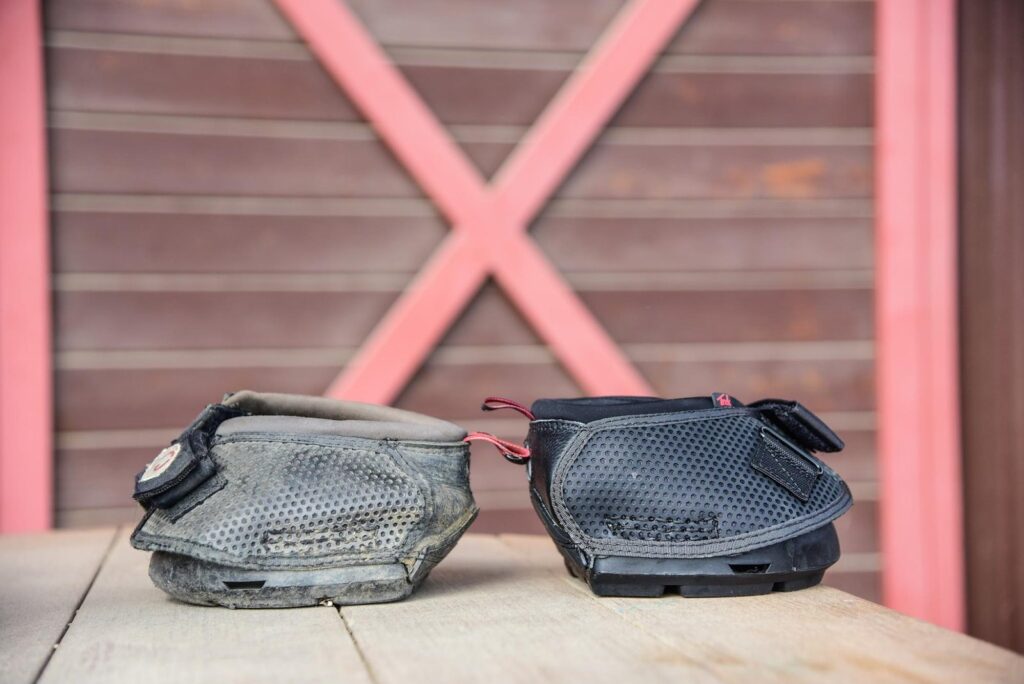
Cavallo boots provide coverage around the hoof and include padding at the heel bulbs. As the boots are worn, that padded material begins to conform to the individual foot.
Flexibility through the upper is important as well. A hoof is not a rigid block. It changes as it accepts and releases the horse’s weight, particularly through the back of the foot. We want a boot to protect the hoof while still respecting that natural movement.
For horses with particularly sensitive skin, Comfort Sleeves or Pastern Wraps can provide additional protection, especially while new boots are settling in or during longer rides.
Think about Where Your Horse Will Be Travelling
The ground under your horse’s feet tells you a great deal about the protection you need. A horse travelling over rocky trails faces very different conditions from one working primarily in a groomed arena or moving over soft pasture.
A good hoof boot sole needs to protect against rocks, hard ground and abrasive surfaces while still providing useful traction. Cavallo soles include shock-absorbing material, an all-terrain tread and a built-in breakover at the toe.
Breakover is simply the point in the stride when the heel lifts and the hoof begins to roll forward before leaving the ground. A well-designed breakover helps support comfortable, efficient movement rather than making the horse work against the boot.
When additional traction is needed—for example on slippery frozen ground or wet grass—studs can also be added.
Drainage and ventilation matter when horses are moving through mud and water, but there is a balance here too. Openings need to allow water and debris to escape without being so large that stones and other material can easily get inside.
Choose a Boot You Will Be Happy to Use
This is more important than it may sound! The finest piece of equipment in the world is not much help if it is so complicated that it ends up sitting in the tack room.

A hoof boot should be straightforward to put on, remove, clean and maintain. Simple closures are particularly helpful for younger riders and anyone who has reduced strength or dexterity in their hands.
Everyone loves a front-opening design because you can apply the boot while working primarily from the front of the horse rather than continually reaching around the back of the leg.
And, as every horse owner knows, horses can be remarkably hard on their equipment! Replaceable closures and fewer unnecessary pieces of hardware can make a real difference in a boot’s useful life.
Which Cavallo Hoof Boot Is Right for Your Horse?
Once you have the hoof measurements, understand the shape of the foot and know how you plan to use the boots, choosing between the Cavallo styles becomes much easier.
Cavallo Trek
TREK is an extremely versatile boot and a favourite for trail riding, arena work, jumping, turnout, transport and rehabilitation support. Its flexible Pro Mesh upper is available with both Slim and Regular soles.
Cavallo Simple
SIMPLE is our original Cavallo design. Its leather upper gradually conforms with use, creating a durable, dependable boot for trail riding and everyday use. It is available with both Slim and Regular soles.
Cavallo ELB
The ELB, or Entry-Level Boot, has a lightweight 1680D nylon upper and is a great choice for light trail riding, conditioning, casual riding, transport and occasional hoof protection, available in Slim and Regular soles.
Cavallo Sport
SPORT uses a side closure with industrial elastic and works particularly well for average- to heavier-built horses. Reflective piping provides added visibility for road riding and lower-light conditions, with Regular and Slim soles available.
Cavallo CLB, BFB and LEB
We have also designed boots for hooves that don’t fall into typical horse sizing and proportions. The CLB is made for miniature horses and small ponies, while the BFB provides larger sizing for draft horses and other breeds with big feet.
Donkeys are different again. Their hooves tend to be more elongated, which is why we created the LEB specifically with those feet in mind. Mules can go either way. Some fit nicely into horse boots, while others have a longer, narrower shape, similar to donkeys.
What about Hoof Boot Pads?
Pads can add cushioning and comfort and can also take up a small amount of extra room immediately after trimming.

They may also be used as part of a therapeutic plan for horses dealing with hoof sensitivity, bruising, laminitis, abscesses or other hoof problems. Every therapeutic situation is different, though, so consider pad selection and boot use with your veterinarian and hoof-care professional.
Pads are also useful for fine-tuning an otherwise appropriate fit, but they shouldn’t be used to compensate for a boot that is substantially too large.
Will a Horse Become Dependent on Boots?
This is another question we hear frequently, and it helps to change the way we look at it.
For a healthy barefoot horse, boots can simply be another useful piece of equipment. Your horse may live very comfortably barefoot and only need boots when you head out onto more demanding terrain. The hoof remains uncovered during normal daily movement, and you provide protection when the conditions call for it.
A horse wearing boots during rehabilitation or because of ongoing hoof pain is a different situation. In those cases, the horse’s comfort should guide the process along with the advice of your veterinarian and hoof-care professional.
Boots aren’t about creating dependence. They are about listening to the horse and giving the hoof what it needs on that particular ground, on that particular day.
What Should You Consider Before Buying?
Before choosing a hoof boot, consider:
- Accurate length and width measurements taken after a fresh trim
- A sole shape suited to the shape of the hoof
- Protection appropriate for the intended use and terrain
- Coverage around the hoof and heel bulbs
- A flexible upper with a secure, adjustable closure
- Suitable traction and shock absorption
- Easy application, removal, and cleaning
- Compatible pads, wraps, studs, and replacement parts
- A dependable warranty and customer support
- Access to knowledgeable sizing assistance
Price matters, of course, but the best value is a durable boot that fits properly, keeps your horse comfortable, is easy to use and comes with knowledgeable support that serves both you and your horse over time.
And Please – Ask for Sizing Help
Sizing is one of the most important parts of successful hoof booting, and you don’t have to figure it out alone.

Measurements that sit right on a size boundary, unusual hoof proportions, flares, long toes or differences between feet can make the correct choice less obvious. This is exactly why Cavallo offers sizing assistance using your horse’s hoof measurements and photographs.
For the best recommendation, take your measurements and photographs immediately after a fresh trim. Use a measuring device with clear markings, and photograph the hoof clearly from the requested angles.
Choosing hoof boots really doesn’t have to be complicated. Start with a freshly trimmed hoof. Measure carefully. Look at the actual shape of the foot in front of you and think about the ground you are asking your horse to travel over.
A well-fitted boot should feel secure, comfortable and uncomplicated—for you and for your horse.
And at the end of the day, comfort is what we are really trying to achieve. When a horse is comfortable, they are more willing to move. And movement is where strength, healing, and so much of our enjoyment with our horses begins.
Ready to choose?
Find the Right Boot for Your Horse
Once you have the measurements, know the shape of the foot and how you plan to use the boots, compare every Cavallo boot side by side.